


AI agents thatwork around every trip
Nezasa For

Airlines
The Packaging Platform for Airlines

Tour Operators
Grow your business by delivering the best experiences

Enterprise
Connect it all and sell your itineraries online
Airlines
The Packaging Platform for Airlines
Tour Operators
Grow your business by delivering the best experiences
Enterprise
Connect it all and sell your itineraries online
AI agents thatwork around every trip
In short

Tai Workbench by Nezasa is an AI-native agent platform for travel sellers. It provides built-in and custom AI agents for the operational work around every trip: checking itineraries, answering booking and business questions, locating travellers during an incident, and reporting on a schedule. Agents work from live Nezasa TripBuilder booking data, read-only, within boundaries you set, and traveller personal data is anonymised before it reaches a model.
Nezasa supports the best in the industry





After the booking
AI already does a good job at the front of the trip: inspiration, itinerary creation, planning. The work after the booking is a different story. Every change still needs judgement and context, and handling that by hand does not scale. One airline schedule change in late December moves hotel nights, transfers and documents across every booking on that route, a week before peak season starts.
Your team is not the bottleneck. The tooling around them stopped keeping up.
Cost 01
Changes, cancellations and schedule moves tie up your operations team, and the work around a booking grows faster than the bookings do.
Cost 02
A trip that was profitable the day it was sold is not necessarily profitable the day it travels, because every change in between moves the numbers, and almost nobody is watching that in aggregate.
Cost 03
When friction reaches the traveller, you carry the cost, and it is often unrefunded.


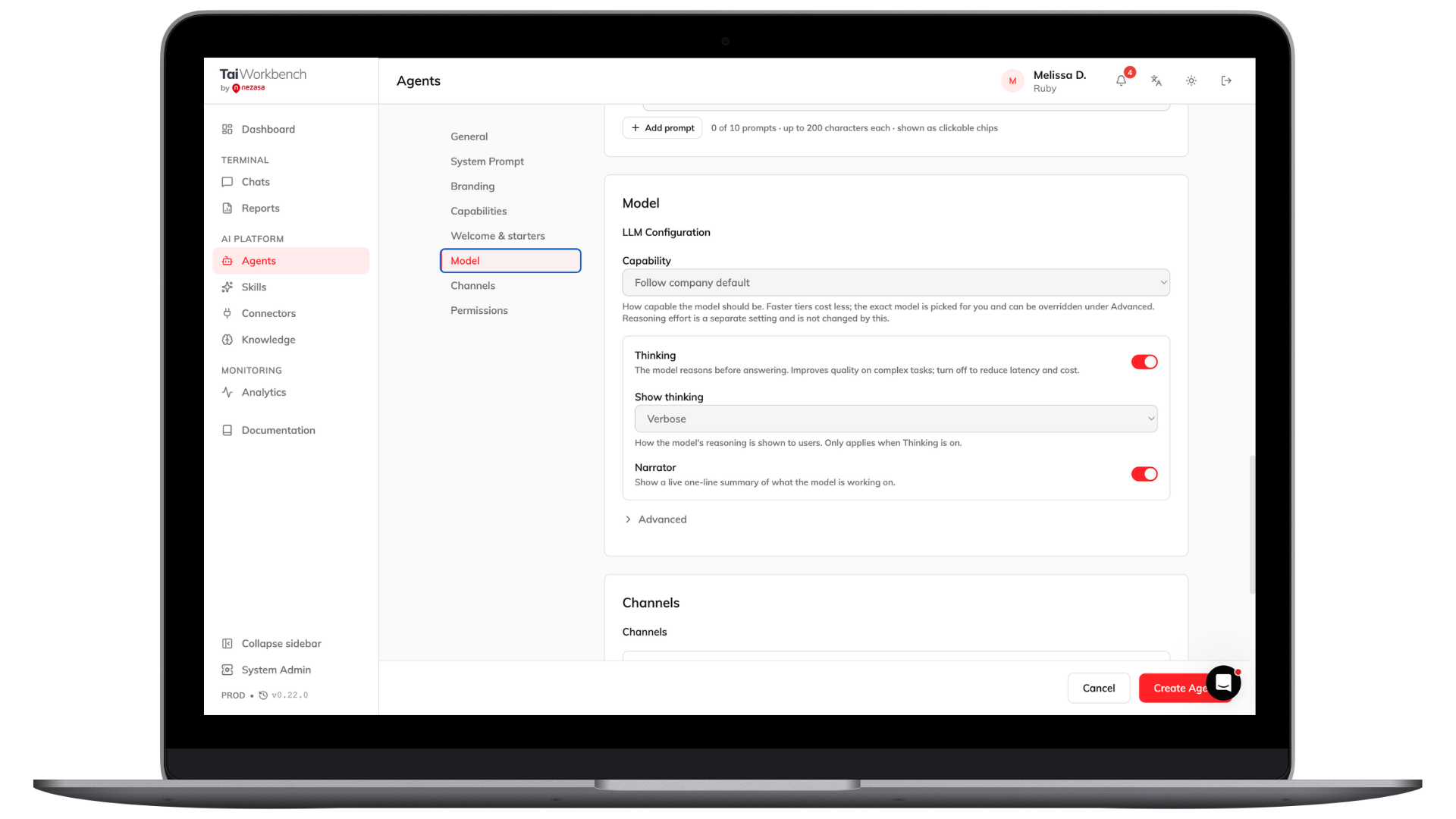
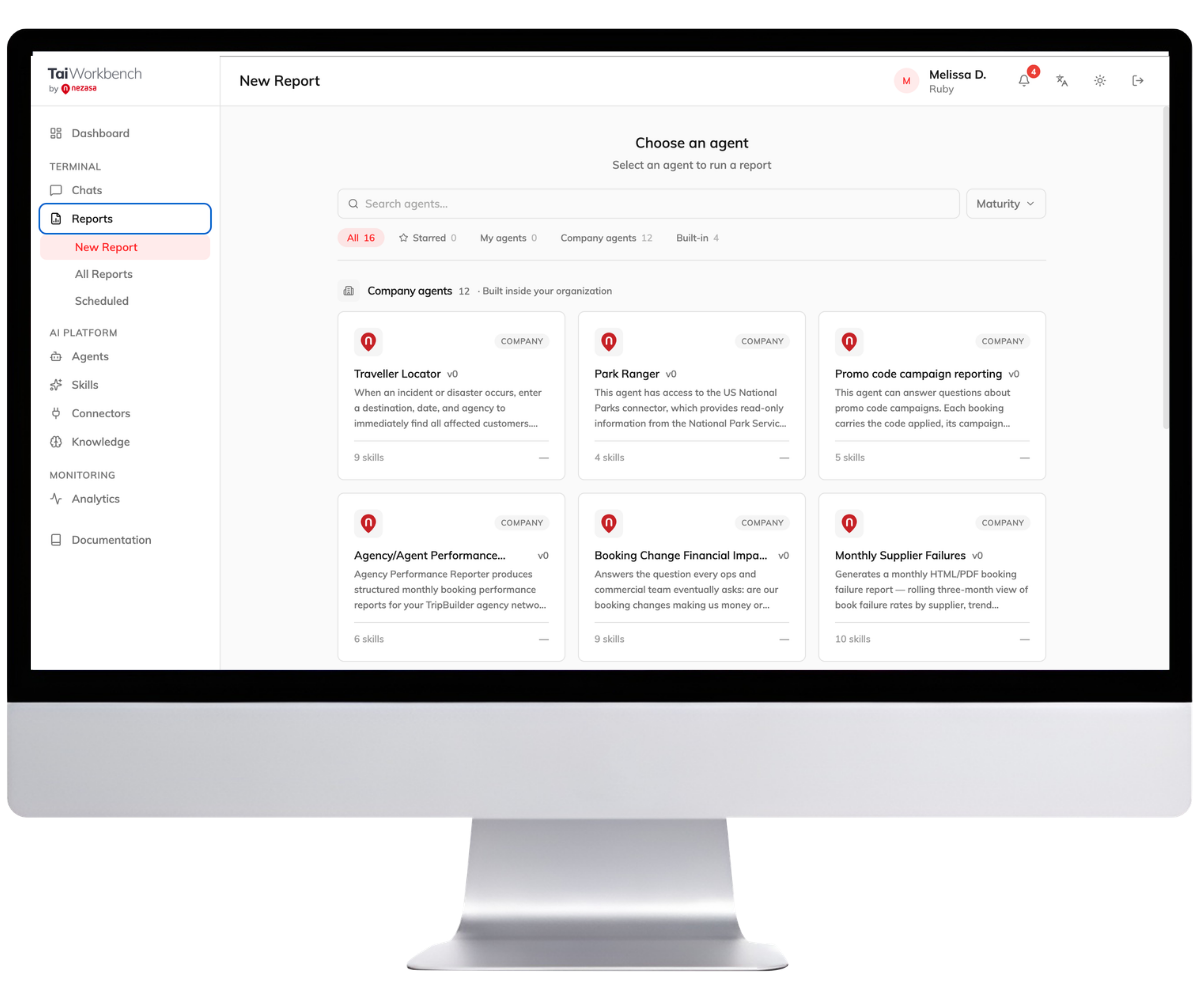
Build a custom agent for the workflow only you have: one agent per job, connected to the data you choose, available to your whole team. Everything is configuration, not code. Pick its skills, assign its connectors and knowledge, and set its model by how much reasoning the job actually needs: simple retrieval runs on a lighter model and costs less, while complex analysis gets the default.
You do not start from a blank prompt box. There are around ten proven starting points, and if none of them fits, describe the business case and the advisor drafts the prompt, attaches the skills and connectors it thinks the job needs, then reviews your test runs and recommends improvements. The first result is rarely the one you want; the second is much closer. Agents start private to you, so you can build and test without anyone seeing the rough version, then release them to your team when they earn it.
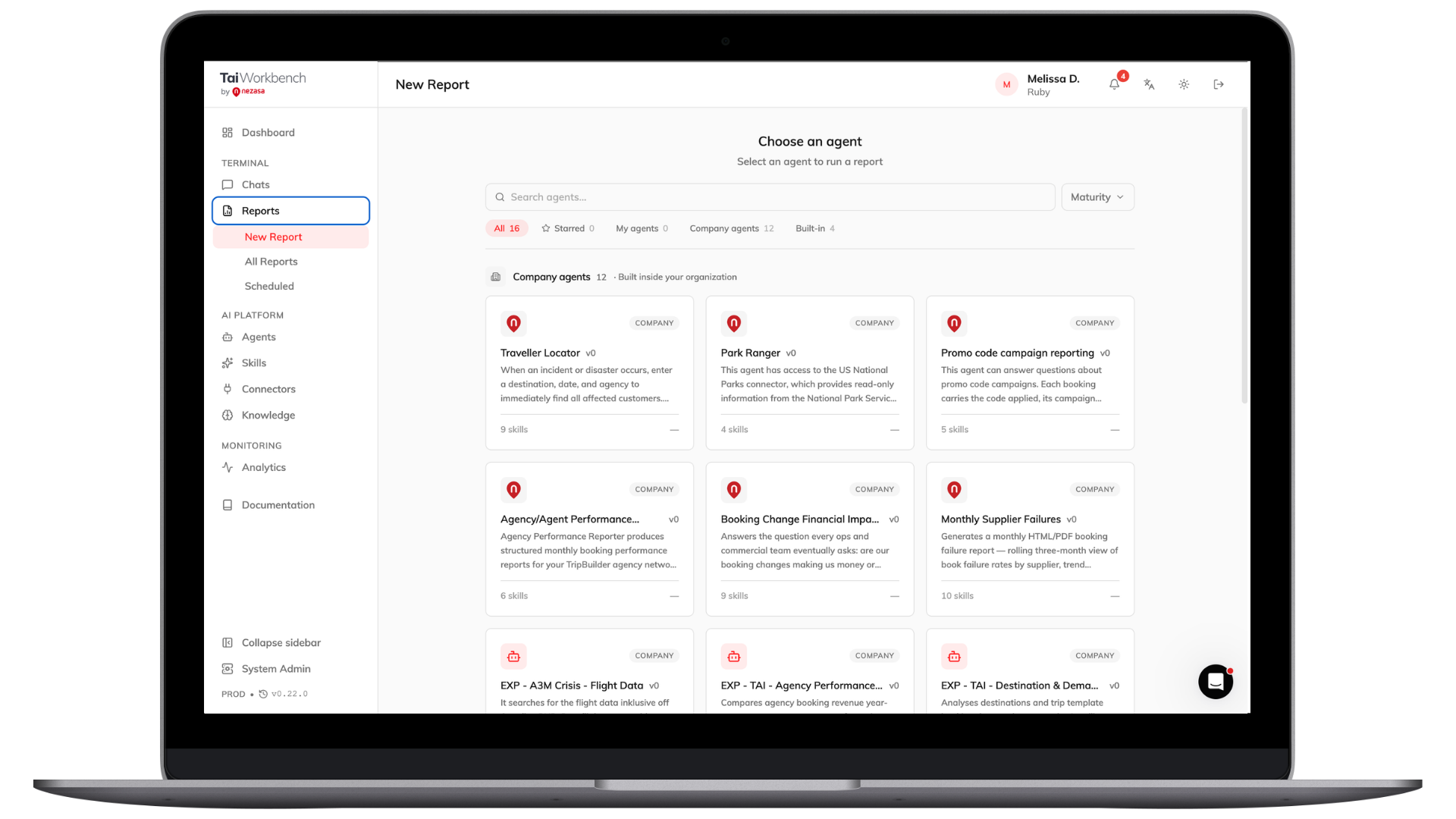
Any question an agent can answer, it can deliver as a report: a formatted, shareable document with visualisations, exportable as HTML or PDF. Set the cadence, add up to twenty recipients, and it arrives as an attachment without anyone opening the workbench. The people who need the answer get it without needing to know an agent produced it. Scheduled reporting exists because private-preview customers asked for it.
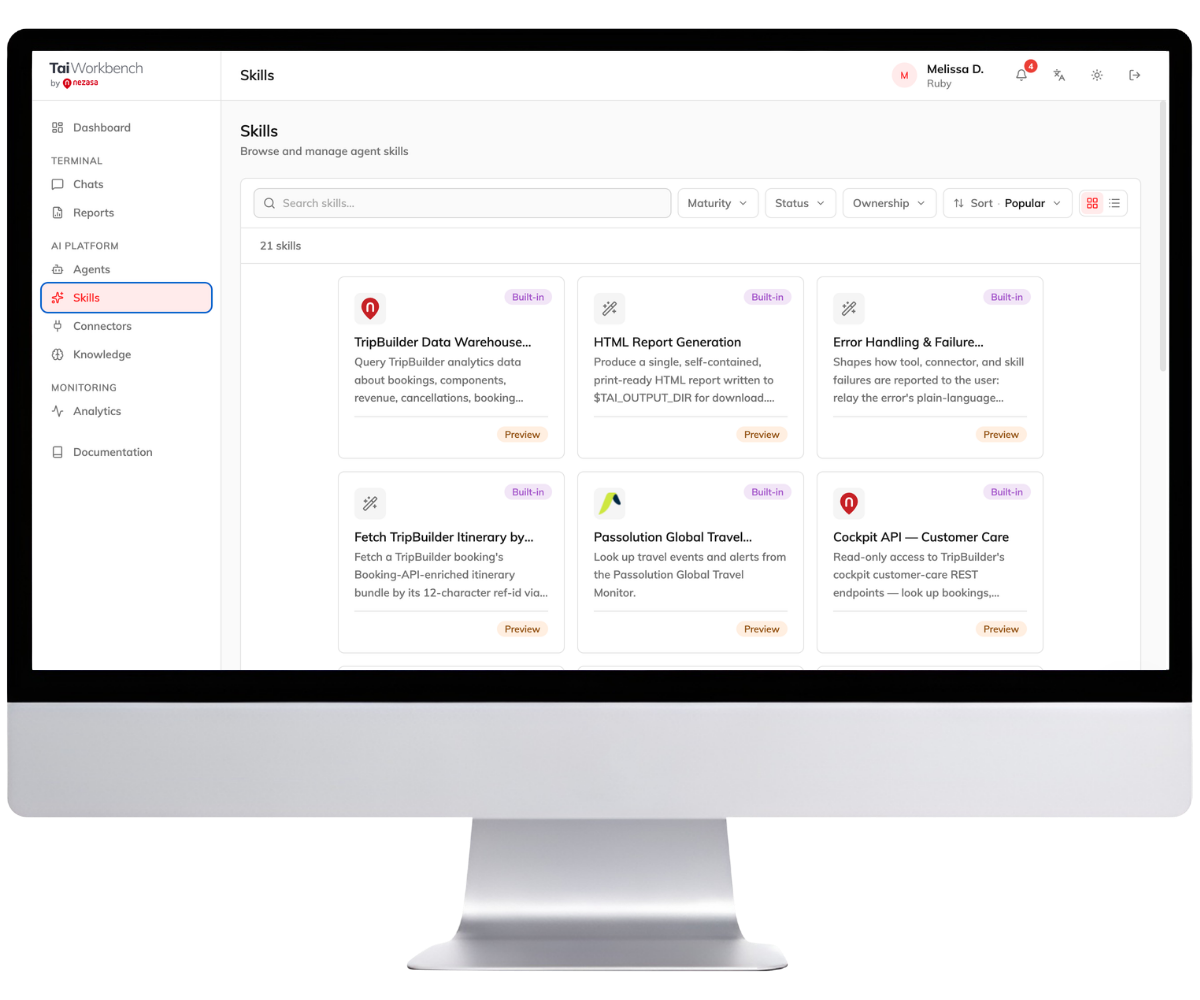
An agent reaches only the skills, connectors and knowledge you assign to it. Nothing gets access it was not explicitly given, and credentials are never exposed to agents or users.
The built-in agents find, flag and report. They never change a booking. Custom agents are read-only by default, and if you choose to give one write access, you decide exactly what it can act on and where.
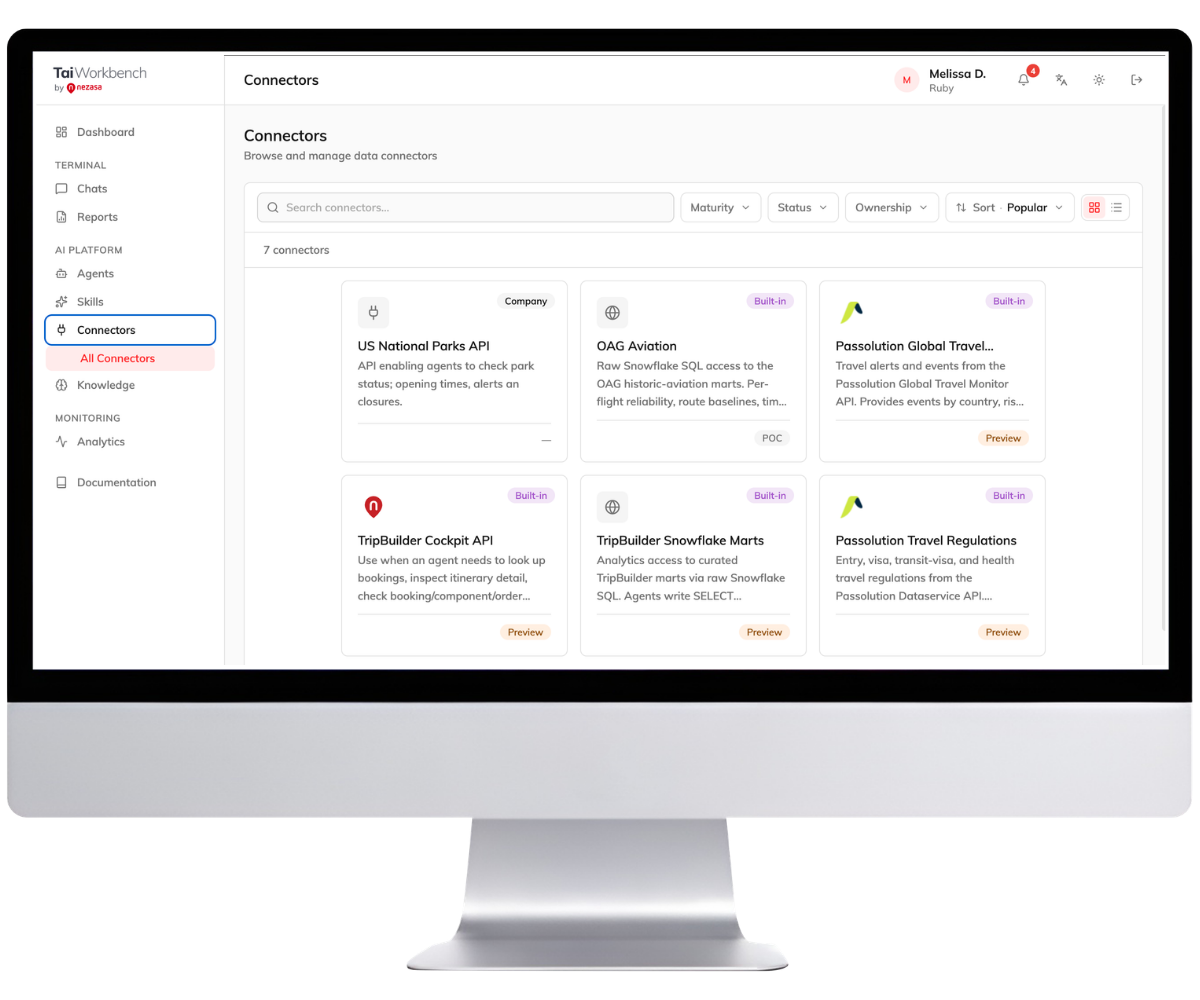
Every company’s data and agents are isolated in their own tenant, and every agent action is logged immutably: what ran, on whose behalf, and against which data. Retention and export controls sit in the platform layer rather than being set agent by agent, so the same rules apply everywhere. Your admins see what the company is consuming and which agents drew it, in one place, through the month rather than at the end of it.
A harness sits between every agent and the model that runs it. It shapes context, holds the balance between answer quality, speed and cost, and keeps agents portable, so your agents improve as models improve rather than being rewritten each time the landscape moves.

The AI companies behind the model do not have access to your prompts, your responses or your logs, and there is no model training on your data. Traveller personal data is anonymised before any request leaves Nezasa: names, contact details, gender, date of birth, nationality and passport details are replaced with placeholders, and restored only in the answer your user sees. Fully PII compliant and GDPR compliant, with comprehensive auditing.
Check our frequently asked questions about Tai Workbench
What is Tai Workbench by Nezasa?
Read MoreAn AI-native agent platform for travel sellers. It provides built-in and custom AI agents for the operational work around every trip: itinerary checks, booking and business intelligence, traveller location in incidents, and reporting, all grounded in your live booking data.
How is Tai Workbench different from TripBuilder?
Read MoreNezasa TripBuilder is the packaging platform that plans, books and manages trips. Tai Workbench is a separate agent platform for the operational work around those trips: native to the platform, not married to it. They work together, agents read live TripBuilder data from day one, and neither replaces the other.
Can agents change our bookings?
Read MoreThe built-in agents are read-only: they find, flag and report. Custom agents are read-only by default, and if you choose to give one write access, you decide exactly what it can act on and where. Every change still happens in Nezasa TripBuilder, by your team.
Is the TripBuilder integration two-way?
Read MoreNo. Tai Workbench reads from Nezasa TripBuilder; it does not write back. Agents look up bookings, review traveller history and answer analytics questions, read-only and scoped to what each user is already allowed to see. Booking detail is read live, so a lookup reflects the current state of the booking, while aggregate analytics come from your Nezasa data warehouse and typically refresh daily. Every change to a booking still happens in TripBuilder, by your team.
Do we need to build or train any AI?
Read MoreNo. Built-in agents ship ready to use, and custom agents are assembled through configuration: skills, knowledge, connectors and a system prompt. There is no model training and no infrastructure to run.
Which AI model does Tai Workbench use?
Read MoreTai Workbench is LLM-agnostic. You choose the model per agent based on how much reasoning the job needs, and agents improve as models improve, with nothing to rebuild.
What data does Tai Workbench need access to?
Read MoreYour live Nezasa TripBuilder booking data, and the aggregate analytics already sitting behind your reporting. Nothing has to be prepared, migrated or newly integrated. Access is read-only and scoped to what each user is already permitted to see, each agent reaches only the connectors and knowledge you assign it, and traveller personal data is anonymised before any request leaves Nezasa. Beyond that you decide: add your own contracts and policies as Knowledge, or connect another system when you want agents to answer from it.
Is our travellers' personal data sent to the AI model?
Read MoreNo. The AI companies behind the model do not have access to your prompts, your responses or your logs, and there is no model training on your data. Traveller personal data is anonymised before any request leaves Nezasa: names, contact details, gender, date of birth, nationality, passport and travel agent details are replaced with placeholders, and restored only in the answer shown to your user. The same protection covers your commercial detail, so net prices and margin data are held to it as tightly as a passenger's phone number. Each company's data and agents are isolated in their own tenant, credentials are never exposed to agents or users, and activity is logged throughout.


